








Kundenlogin
Wenn Sie noch kein Kundenkonto haben, können Sie sich hier registrieren. Sollten Sie Ihr Passwort vergessen haben, können Sie hier ein neues Passwort anfordern.
Wenn Sie noch kein Kundenkonto haben, können Sie sich hier registrieren. Sollten Sie Ihr Passwort vergessen haben, können Sie hier ein neues Passwort anfordern.

Mazur, Piotr S.
The Paradoxes of the Person
A New Thomistic Perspective. Translated by Ewa Palka. The monograph addresses the traditional problem of the paradoxes of the person: being and becoming, incommunicability and communicability, being part and being a whole, as well as being open and being covered. Rejecting extreme interpretations that regard these paradoxes as expressions of logical-epistemological errors or man’s contradictions and absurdities, Mazur treats them as anthropological facts in need of systemic explanation. The paradoxes of the person, like other ontic paradoxes, are expressions of oppositional properties of the person that are also present in beings other than man. However, why do the oppositional properties present in various beings lead to paradoxes only in man? Referring to classical metaphysics, the author argues that the paradoxicality of the opposition between the properties of the person stems from something superadded to the analogous properties of other beings. The extreme opposition of the properties of the person manifests in him not only the presence of something superadded and thus transcendent in relation to other beings, but above all the extraordinary richness and multifacetedness of his existence. IX,152 Seiten, broschiert (Harrassowitz 2024) leichte Lagerspuren/minor shelfwear
Bestell-Nr.: 124784
ISBN-13: 9783447122672
ISBN-10: 3447122676
Erscheinungsjahr: 2024
ISBN-13: 9783447122672
ISBN-10: 3447122676
Erscheinungsjahr: 2024
Vorheriges Buch Zum Sachgebiet 'Philosophie des 20./21. Jahrhunderts' Nächstes Buch
Weitere Bücher im Sachgebiet »Philosophie des 20./21. Jahrhunderts«


Eich, Corinna Deborah
Transformation und Werden
Eine Kritik des transformatorischen Bildungsverständnisses nach Koller mit …
Transformation und Werden
Eine Kritik des transformatorischen Bildungsverständnisses nach Koller mit …




Schrader, Gertrud
Kunst und Wissenschaft als parallele Erkenntnisformen
Technologien und Prozesse der Digitalisierung aus philosophischer und künstlerischer …
Kunst und Wissenschaft als parallele Erkenntnisformen
Technologien und Prozesse der Digitalisierung aus philosophischer und künstlerischer …


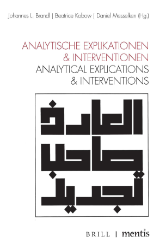
Analytische Explikationen & Interventionen/Analytical Explications & Interventions
Ein Salzburger Symposium für und mit Georg Meggle
Ein Salzburger Symposium für und mit Georg Meggle